Sunday, 7 December 2008

Barriers - to understanding ?

Not for the first time Blacka Blogger is at a loss for words in attempting a reaction to the latest SWT project so, will simply explain the context. More than a year ago they decided to fence off a much used route across Blacka Hill due to erosion. In conservation terms they claimed concern about the peat degrading. Notices were put up and barriers at each end of which this is one, although originally the uprights rose a foot or so above the horizontal bars and were a gross eyesore.

The barriers drew some uncomplimentary comments. After a month or two an SWT worker came along with a saw and reduced the height of the uprights which certainly lessened the clumsy visual impact in an attractive area. At a RAG meeting on site in June SWT remarked that they would address the visual intrusiveness of the barriers by replacing them with 'hurdles'.

Eventually one barrier was removed and a broad hurdle like structure appeared to replace it. This frankly defies description, but one should say that at each end there was a kind of extension, as if by afterthought, using two of the bars of the previous barrier. The pictures I hope tell something if not all of the story:


This tale is now approaching its climax: Several weeks later, on Friday, those who had thought nothing stranger could happen were to be surprised. At the other end of the route the original second barrier remained, but beyond it a new, even more striking artefact had materialised.


Blacka Blogger is now about to write to the Royal Institute of British Architects with a view to nominating SWT for an award in the category of "structures which enhance the landscape".

Saturday, 6 December 2008

SWT Bash Event

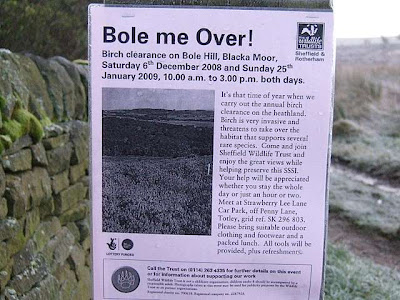
Curiosity took us to Bole Hill this morning to check out the major SWT volunteer 'birch bashing' event. Blacka Blogger disapproves of the clearing of birch and other trees - certainly in the way SWT approach it. And we have made our feelings known to the reserve manager to the effect that mature native trees like scots pine, oak, holly and rowan should not be summarily massacred all in the interest of blindly following a purist creed that prioritises treeless heather moorland.


This morning's event had been widely publicised with appeals on notices around the moor and also in the local Sheffield Star so it was interesting to see how many had turned up to respond loyally to the call from their local wildlife trust. The meeting place was the Strawberry Lee car park at 10 a.m. So, making our way there we were surprised to find barely more vehicles than normal for a fine sunny morning, at least one of which belonged to two men with children and dogs coming down from Lenny Hill.


On arriving at the top of Bole Hill it took some time before we located the party of keen bashers. A clue had been provided by the sight of deer hurrying away in flight from their favourite secluded woodland. The party of four volunteer workers were busying themselves with long handled clippers removing twiggy growths from birch in the woodland.

Two things puzzled me. One was the small number of volunteers. Of course it 's possible that dozens arrived later in the day but somehow unlikely. Secondly if the priority is keeping the areas of heather free from birch why were they nor removing the numerous twiggy growths visible in the heather instead of working inside woodland which had already established itself? It could be that the lower twigs were being removed to make it easier for SWT's trained chain-saw operators to cut down these trees in the coming week. But the whole thing seems somehow to suggest going through the motions of an unrealistic task.

If they are intending to cut more of this stretch of woodland I shall be very annoyed: these woods are a particular valued area where the deer retire during the day. But then when did SWT really care for the interests of wildlife?

Tuesday, 2 December 2008

Access Impeded


The sealing off of the parking space at Piper House on Hathersage Road is already having a serious impact on the ability to visit Blacka Moor from this side. The other car park below Stony Ridge accommodates only a small number of cars and on mornings like this one is potentially troublesome due to the sloping exit. It only needs one vehicle to be parked inconsiderately across the space instead of facing into the wall and at a stroke only two cars can get in as happened this morning - just when you need some leeway in case of snow and ice being a problem.

My letter to the Head of Transport and Highways has not yet drawn a reply nor even an acknowledgement. It was sent on 12th November.

The farm gate onto the moor is still padlocked. The promise from SWT's reserve manager was that it would be opened on Monday.
Admittedly the frozen ground means that the main problem of mud around the pedestrian gate is temporarily suspended, but it will come back just as quickly.

The trees on the lower slopes of Bole Hill were looking in good shape this morning. How many of them will survive SWT's coming festival of arboricultural vandalism we will discover on Saturday. It may be that the red deer will need to seek out another secure asylum.

Monday, 1 December 2008

Can You Believe It ?

Further to the previous post immediately below. Nothing can illustrate more perfectly the utterly mixed up thinking behind the persecution of trees on Blacka than SWT's own leaflet entitled Blacka Moor Nature Reserve. The feature photograph on the front shows two birch trees on the moor, a characteristic of this landscape. Those trees and dozens more like them have now been cut down. On Saturday SWT are inviting visitors to Blacka to help them cut down more native trees including scots pine, oak and anything else that they do not like.

Sunday, 30 November 2008

Maximum Intervention - an appeal


At the lengthy 2006 consultation (Icarus Process) there was agreement among the participants that Blacka should be managed as wild land with 'minimal intervention'. No argument was raised against this by SWT or others from the conservationist industry, though it's fair to say that one or two of them did look just a little uneasy. Since then we've had cattle on the moor, barbed wire fencing has become a fixture and a previously open section of the moor has been walled and fenced in with awkward gateways imposed on hapless visitors.


This autumn much chain-saw activity has been ongoing with whole swathes of mature trees falling to the fervent management agenda. The notice seen at entrances shows that this has not finished yet. In fact the text invites members of the public to come along and help in this compulsive activity. Blacka Blogger opposes this for several reasons, chief of which is the inability of SWT to effectively explain their actions with anything other than a kind of 'it's the thing to do' defence. What is usually trotted out when you complain is that they have to manage the area as heathland and if pressed they tell you that heathland and moorland are key habitats for certain species. Heath is of course an artificial landscape and nature long since determined that it was not to have a pure future on Blacka Moor. The spread of native tree species here is largely responsible for Blacka's landscape and wildlife appeal. After all those who want broad treeless spreads of moorland are spoiled for choice in the northern Peak District and then on up the Pennines to Scotland and beyond. The suggestion that all this is endangered, putting it on a par with rain forests, is frankly disingenuous. And as I say it is an artificial, man-made landscape. The trees are bringing back some of the spirit and the nature and wildlife of many centuries ago.


Querying this with SWT's reserve manager has elicited the fact that cutting trees on Bole Hill will not be confined to young birch ('scrub') but will also include taller mature trees some of which may be oak, scots pine, beech, rowan and anything growing near heather. If I'm the only one who finds this to be draconian then perhaps it's time to stop writing this blog in despair.


Much could be said in arguing against this cull of wildlife. But just to mention two. The spread of trees over Blacka has resulted in two wonderful wildlife phenomena that some of us are out here enjoying when SWT's staff are crouched over their workstations filling in grant application forms and compiling management schemes. In spring the arrival of migrant songbirds brings a heart melting medley of optimism to the newly greened foliage of birch, rowan and other native trees. They are not to be heard out on the purer and less interesting moorland of Burbage and Bleaklow etc., because they love deciduous trees. The reappearance of red deer is due almost entirely to the cover the trees provide into which they can retire when people are about. You cannot easily get close to deer on Bigmoor. On Blacka the groups of trees, the isolated scrubby growth gives deer a sense of security. We've seen deer more often close to trees on the moor than anywhere else. (Click on the picture below to get a larger image, and see the hind.)

The small birch woodland at the base of the western end of Bole Hill (picture below) is a regular and secure haunt of Blacka's red deer and should be avoided at all costs by those wielding chain-saws and other tools of destruction. In fact they should stay away completely
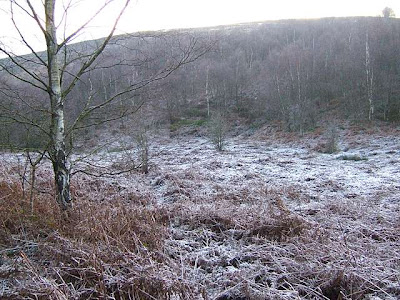

So to the appeal. If anyone reading this post is even considering a bracing activity out in the open air this Saturday helping a wildlife trust (and what could sound more healthy and worthwhile, put like that?) please think again. Better still write to the trust or phone them saying that mature trees and other native species should be spared, whatever they choose to do with small birch growth.

If this is minimal intervention what would maximum intervention be? ...ploughing it all up and planting cabbages?

Gated


All the years I've known and walked on Blacka Moor it has been open and easily accessible. At the point shown in these pictures (taken on Thursday) there is now a long stretch of fencing and stone walling installed only last year. Previously one just wandered onto the moor, choosing one's route though most people usually tended to go the same way making an informal path. Somewhere I've read in SWT's paperwork or publicity that they tell the story that they have 'improved access to the moor' by putting in these gates. Gates are nearly all around us just here and it's a bit of a joke that they improve anything. What they do of course is to make it possible for them to manage the place as farmland for grazing rather than as the unfettered landscape that it's always been. I suppose they could have chosen to extend walls and fences right across making it necessary for us to climb over the wall, so we should be grateful .... as indeed we should for the barbed wire they put in elsewhere.

Now one of the unintended but wholly predictable consequences of this is that all foot traffic is focused on one small pinched area and it therefore gets uncomfortably mucky and even risky to negotiate.
This increased alarmingly last winter causing interesting problems for lone walkers never mind those accompanied by a child and a dog. At a RAG meeting in June a request was made for the adjoining farm gate to be unlocked when cattle were not on the moor. This was accepted at the time but nothing was done about it - a familiar story with SWT. The cattle have of course not been on the moor at all this year, so there has been no reason for a padlock at all, given that before last year the whole stretch of land was unfenced and completely open. We were beginning to pray for a hard frost to come along and dry up the mud at least temporarily.


Recently a request for the ground beneath the 'kissing gate' to be covered with wood chippings or similar was met with the response that this would be 'importing nutrients into a low nutrient soil type'. Those who see this as being precious to a barely credible degree should draw back and be more tolerant - this is SWT after all.

There is now a promise that the farm gate will be locked open any day now. Interestingly when arriving at this point on Thursday morning the other gate (below) to the bridleway into the pasture land was stuck open, having presumably been like this all night. Fortunately none of the sheep or cattle, so far as we could see, had taken advantage of this to embark on a tour of the surrounding moorland.

Saturday, 29 November 2008

Above It All

(Click on pictures to see larger images)


One of the best early morning walks of the year. But those below in Sheffield waking up smothered in thick fog were unaware of what they were missing. If they staggered to the bedroom window and saw the car cased in ice they probably jumped back under the duvet.


But it was worth the effort after so many damp grey mornings.

Temperature inversion mornings are always worth waiting for, but when improved by frost and the changing colours of the sunrise you barely notice the cold fingers. The absence of wind, however, was very welcome.